Leitrim prior to the famine.

Updated: Oct 8
Population Decline
County Leitrim, located in the northwest of Ireland, has a rich history marked hardship and in more recent times by hope. The Great Famine of the 1840s was a significant turning point, leading to a mass exodus of people seeking refuge from starvation and poverty. As in every county at the time, Leitrim families were forced to leave their homes, embarking on perilous journeys across the Atlantic to America, Canada, and beyond. This exodus continued for another 150 years.
Emigration has long been a part of Ireland's history, with countless individuals leaving their homeland in search of better opportunities. Leitrims population in the 1841 census was 155,297. In 2022 it stood at 35,000, 22.6% of its 1841 population. It remains the county with the highest population decline since 1841.

Economic Factors
The economic landscape of Leitrim has historically been challenging. The population was always dependent on agriculture, which due to the poor soil known locally as daub and poor drainage was always challenging. Many Leitrim men and women travelled each spring and summer to northern England and Scotland to work the harvest.
In the 18th century flax was grown to some extent for the booming linen industry and also created a local cottage linen industry. Recession in the linen industry and mechanization saw the collapse of the industry in the 1830s.
Mining of Iron ore took place between the 15th and 18th centuries but declined then due to deforestation which was the primary fuel for furnaces. Coal mining around Lough Allen continued in the 19th Century and into the 20th Century. These were localized opportunities.
James McParlan Statistical Survey of the County of Leitrim 1802
James McParlan, a physician, wrote the Statistical Survey of the County of Leitrim for the Dublin Society. It came out in 1802, one of a county-by-county series meant to record the state of Irish agriculture, industry and society after the Union. I will come back to James McParlan in a later blog.
The Impact of Emigration on Families - Separation and Sacrifice
Emigration often meant long periods of separation for families. Letters became a lifeline, connecting loved ones across the ocean. Families who had several members emigrate to different countries, relied on these letters to share news, celebrate milestones, and provide support. The emotional toll of separation was immense, but the hope of reuniting one day kept many going. For many, that hope rested on remittances: money sent home by those already abroad to pay the fares of family members left behind. This created a chain migration that lasted for decades.
Building New Lives Patrick Edward Conley
Despite the challenges, like all Irish emigrants, Leitrim emigrants found ways to build new lives for themselves and their families. Patrick Edward Conley was one of those.
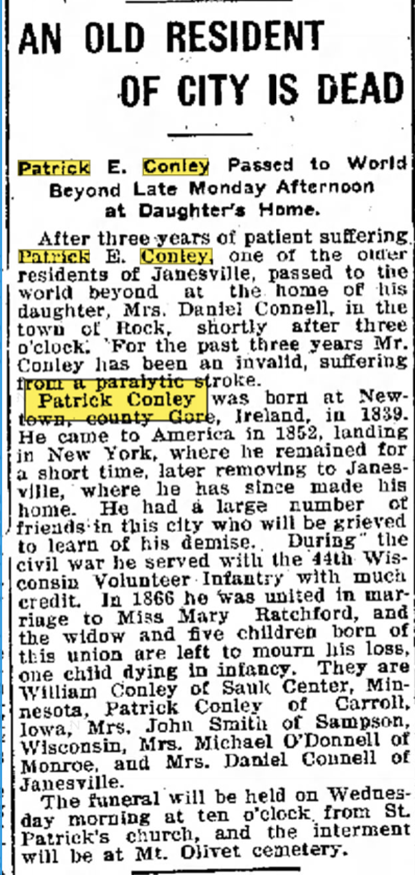
Patrick was born in Newtown Gore in Leitrim on 4 December 1839. He was the sixth child of Catherine Farrelly (Farley), and Thomas Conley His brother John was born about 1842, and a half-brother Francis William in April 1847. He emigrated to America in about 1852.
In 1855 he was living in Rochester City Ward 10, New York with his parents Thomas and Catharine and five brothers and one sister.
He enlisted in the Union Army on 5 Feb 1865 and was mustered into the Wisconsin 44th Infantry Regiment. This unit was employed on guard duty and escorting prisoners and saw no military action.
Patrick married Mary Ratchford (1842 – 1920) in St. Patrick’s church Janesville, Wisconsin in 1866. They had six children. Margaret (Maggie) Conley 1866–1921, Catherine Bridget Conley 1873–1937, Patrick John Conley 1875–1942, William Edward Conley 1879–1928, Mary Ann Conley 1882–1906, Rose Ellen Connelly 1884–1980
In 1880 Patrick was living with his wife Mary and four children in Exeter Green, Wisconsin. He was a farmer.
Pat Conley 39 Self
Mary Conley 38 Wife
Margaret Conley 13 Daughter
Catherine Conley 6 Daughter
Patrick Conley 5 Son
William Conley 2 Son
In 1900 Patrick was living in Spring Valley Rock County Wisconsin. He was a tgenant farmer.
A Daughter Rosella Conley (15) was living with them as was George Lyons (51) who is recorded as a servant.
In 1910 he was still living in Rock County Wisconsin. He was a farmer but owned his own farm and had a mortgage.
He died on 13 July 1914 in Rock and is buried in Mount Olivet Janesville, Rock County Wisconsin. His wife Mary died in 1920.

Comments